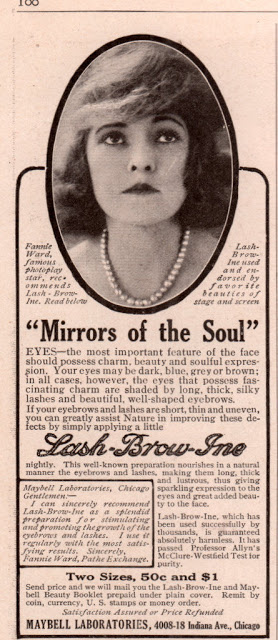
Every single girl in my high school had a tube of Maybelline mascara. It was, to us, the ONLY mascara; plump with promise that your newly enhanced lashes could waft a date your way. There’s a powerful amount of witchcraft in small magic wand
When I put it down, I wanted to know MORE! So, being me, I contacted the author, Sharrie Williams (the grand-niece of Tom Lyle Williams, Maybelline’s inventor), and begged her to allow me an 6. And voila! She not only agreed, this dear lady went out of her way to offer me access to any images she could provide to (in her words), make my blog post “fabulous!”
K: Your book details so much about the hard work your great-uncle Tom Lyle did to link Maybelline with Hollywood. Let’s follow Maybelline’s timeline and see how Tom Lyle’s vision kept pace with American women and Hollywood’s changing cast of characters. Right after the Stock Market Crash of ’29, Maybelline ads featured a slinky vamp in white fox furs that encouraged women to “take these easy three steps to instant loveliness”…can you describe those steps? What are the modern equivalents for today’s vamps?
K: Maybelline was always innovative in so many ways, w knowing how to stay aware of social trends and what American women were craving. When society started frowning on the sultry look, Maybelline’s ad campaigns featured a more wholesome, more demure model with Main St. appeal. Tell us a bit more about the evolution
of advertising looks used and the stars who were featured in them.

S: Both, of course. You see Maybelline was the only eye beauty enhancer on the market at this time and because of its flawless reputation received the Good Housekeeping Seal of Approval, thus he wanted models who emulated that kind of purity. Yet Maybelline also wanted to hold onto the glamour and sex appeal that women wanted as well. Jean Harlow was the blond bombshell of the early 1930′s and her characters did appeal to the hard-boiled working girl who wanted to make it in the world but in the end hoped for the rich man to save her. That was where the working girl of the 1930′s fit into society and Tom Lyle used that knowledge to bring her into the dimestores to buy Maybelline. He wanted every branch of society to come in and buy buy buy, so he played to every aspect of the female market. Natalie Moorhead had sophistication and sex appeal and that too was a now- kind of women emerging during the Great Depression.
S: Yes he was a genius when it came to beauty and perfection. He was almost too much of a perfectionist actually. Every photograph had to be flawless even if he had to retouch until he got what he was looking for. When he looked at anyone, male or female, he envisioned them at their full potential. It would excite him to realize what could be done with a little mascara, shadow and pencil. Even me at 5-6 years old became a subject of potential perfection. Do you remember reading about how my grandmother Evelyn made me up and paraded me in front of him so he could examine my eyes? He said, “You will someday be a beautiful women Sharrie.” He could see past my chubby cheeks and see my bone structure. That was the secret to real beauty–bone structure–as far as he and my grandmother were concerned.
K: Maybelline, Revlon, Max Factor, Helena Rubenstein, and Merle Norman were rivals in the 30’s and are all still in business today. What do you think has kept these companies alive when other cosmetics companies (like Lydia Pinkham) failed?
S: Maybelline never ever had a rival while Tom Lyle owned it. Even when he sold it in Dec of 1967 it owned 75% of the market share. However you must remember Maybelline in those days was strictly devoted to Eye Beauty. The other companies didn’t have a chance because Tom Lyle spent more money on advertising than all companies combined. He didn’t squander money like so many young companies do when they see a little profit. He was the most conservative man I never knew. That’s why Maybelline always survived the ups and downs of the economy. The other companies like Maybelline had quality products and of course spent money on advertising so survived. But even today Maybelline New York which now competes in all product areas has a tremendous advertising budget and it shows. Advertising is the secret to success. Today it’s Social Media but still the idea is the same. Reach the greatest amount of people possible and get your message out. Keep the quality and make it affordable to the average customer. Maybelline’s product was quality, yet sensibly priced.
K: In the mid-30s, when frumpiness receded and flirting was back in style, Maybelline partnered with Lilly Dache, the fascinating Parisian-born milliner famed for daring, darling hats. Please share what you know about that wonderful collaboration. LOVE Dache!
K: One of the loves of Tom Lyle’s life was Alice Faye—what was the appeal of her particular look?
S: She was The All American Girl and Adorable. He liked that personally more than sex queens. But, Alice Faye had an issue with the studio and Betty Grable took the spotlight. Tom Lyle wanted to use Alice Faye’s image in Maybelline Ads, but when the studio announced “Down Argentine Way” and Betty Grable, this is the ad that came out.
Older women shouldn’t rely on as much make-up as they dwoid in their heyday youth. Subdued make-up, tastefully applied is much more attractive than trying to keep up with young girls. For my taste, having a good hair cut and color, soft make-up and simple jewelry is beauty as we age. Also the confidence we gain as mature women is sexy–don’t you think? When I walk into a room now, people still look at me, not for my make-up but the air of confidence I exude. It is ageless and powerful. (Editor’s note: We agree! See Sharrie’s publicity picture below.)
S: Eleanor Fisher won a small part in the film TRUE CONFESSION with Carole Lombard. She never went on to do much more!
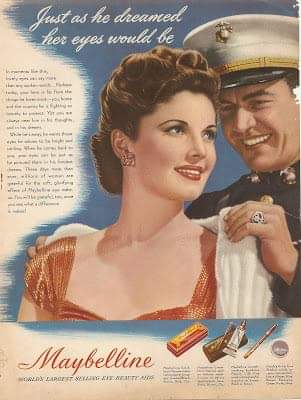
K: How did Maybelline advertise during WWII? What is the idea of “patriotic beauty?”
S: In my book, I share how President Roosevelt was advised by the Pentagon that there must not be a “shortage” of glamour; that such a loss of beauty “might lower national morale.” So, the effect of pretty pin-up girls on the morale of the G.I.s was part of Maybelline’s ad campaigns of that era. It was a repeat of the idea of “Patriotism Through Beauty,” coined in 1917.